
A good BOQ is more than a price document. It’s an end-to-end tool that helps owners, builders, and estimators keep control from day one to final account. When it follows BOQ measurement standards, it becomes a tender comparison tool with real cost transparency, better procurement support, and fewer arguments on site.
In this BOQ guide for clients, the goal is simple: learn the anatomy, confirm measurement standards compliance, follow clear reading steps, and then level tenders before you compare totals. That’s how to analyse a BOQ before tender, how to compare contractor BOQs fairly, and how to reduce variation control issues by spotting scope gaps early. By the end, you’ll know how to interpret BOQ quantities and rates, what “good” looks like in each section, and how to use a practical BOQ checklist (content only) to review any BOQ before you tender.
A Bill of Quantities (BOQ) exists to turn drawings and specs into a clear pricing reference everyone can follow. It works like a financial control document, so owners and builders can plan budgets, compare tenders, and avoid guesswork. It’s also the cleanest way to explain the BOQ vs cost estimate difference.
A good BOQ supports procurement support, fair risk allocation, and contract administration. When scope changes, it becomes the contract pricing reference for valuing variations, so decisions stay consistent and easier to defend.
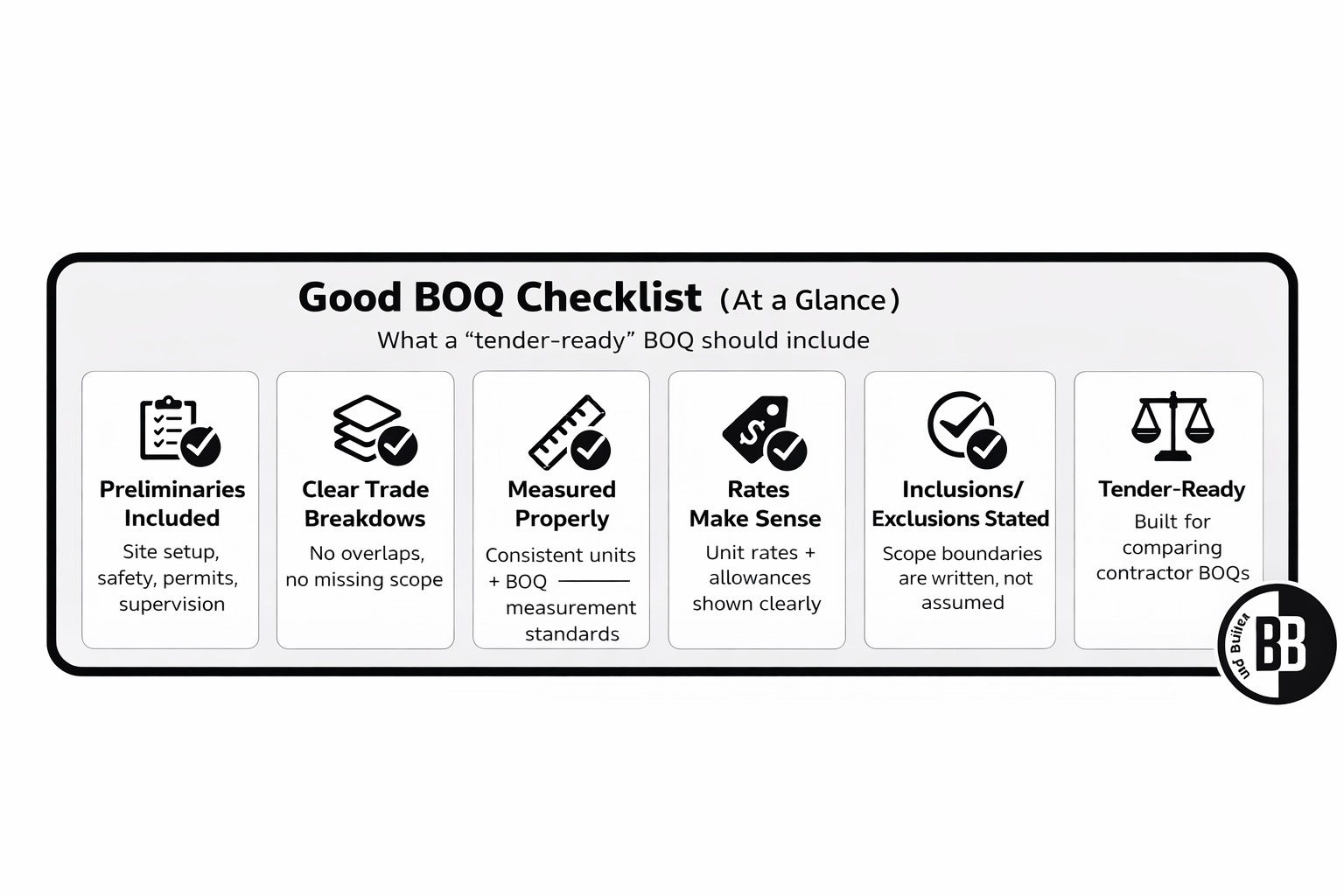
A good BOQ is a structured list that turns the project scope into measurable items you can price, check, and manage. When people ask what is included in a BOQ, the answer should be clear across preliminaries, trade breakdown sections, measurement rules, rates, and scope notes. Think of it as a BOQ components checklist with acceptance criteria: clear descriptions, no overlaps, and no “missing pieces” hiding in assumptions.
Preliminaries in a BOQ cover the costs and requirements that support the whole job, not one trade. This is where common BOQ mistakes show up—because preliminaries and overheads get skipped or buried. A “good” prelims section is detailed enough to support cost transparency and fair risk allocation, so contractors don’t price the same site setup in different places or leave it out entirely.
Trade sections are the core of the BOQ breakdown explained. A trade-based BOQ structure groups work in a logical order (earthworks, concrete, masonry, finishes, MEP, and so on) so scope clarity is easy to see. A “good” BOQ trade breakdown avoids overlaps between trades and makes interfaces obvious—so you don’t get disputes later about who included what, and you reduce variation control problems.
This is where a BOQ becomes measurable instead of “interpretive.” BOQ measurement standards and unit definitions tell everyone how quantities were taken off and how items should be priced. A good BOQ measurement method supports a detailed quantity takeoff in BOQ, so two people measuring the same work arrive at close results. Without this, tender comparisons become messy because contractors price on different measurement bases.
Rates turn quantities into money. A good BOQ explains unit rates in the BOQ clearly and uses a BOQ schedule of rates where it helps, especially for repeatable items. This section is also where you check whether pricing is realistic. If unit rate pricing is unclear, you can’t tell what’s included in the rate, and disputes start. Where needed, rate build-up and labour and material separation make allowances visible and easier to compare.
This is the scope boundary control section. It prevents “I thought that was included” arguments and supports how to analyse a BOQ before tender. A good BOQ spells out inclusions and exclusions in plain terms, lists assumptions that affect pricing, and identifies contingency items with ownership (who carries the risk). This is a major area for common BOQ mistakes, especially when exclusions and inclusions are scattered or vague.
Reading a BOQ is easier when you follow a fixed order. Don’t start with totals. Start with the rules, then check quantities, then check prices. This simple sequence improves scope clarity, protects measurement standards compliance, and helps you avoid misreading unit rate pricing. It’s the most practical way to learn how to read a bill of quantities.
Use these BOQ reading steps every time: notes first, quantities next, rates last. This approach keeps the BOQ breakdown explained in plain terms and helps you spot gaps before they become variations.
This is where the BOQ tells you “how to read me.” BOQ notes and BOQ rules include prelim notes, measurement rules, and what is included in a BOQ versus what is excluded. If you skip this stage, you can’t judge the rest fairly. A good BOQ will clearly state BOQ measurement standards and any assumptions that affect pricing. Treat this as your contract pricing reference for interpretation.
Now you validate the work content. Go trade by trade and focus on quantities before money. This is quantity-led validation: you’re looking for missing trades, duplicated scope, and unrealistic quantities. A detailed quantity takeoff in BOQ should feel consistent—units make sense, descriptions are measurable, and the scope reads complete. This step supports scope clarity and helps with variation control because gaps in quantities often turn into claims later.
Only after quantities look right do you review pricing. This is where unit rates in BOQ matter. Check for rate sanity, allowance flags, and signs of an unbalanced tender. Rates should match the item description and unit. If the BOQ allows it, look for rate build-up logic and labour and material separation on key items, so you can see what the price actually covers. This makes BOQ rate review practical, not guesswork.
Before you accept any tender, you need to “level” the BOQ so you’re comparing like with like. This is the heart of how to analyse a BOQ before tender. A simple tender leveling process improves scope clarity and cost transparency, and it turns the BOQ into a reliable tender comparison tool instead of a confusing pile of numbers.
Use a BOQ comparison checklist to normalise scope, align prelims, confirm the measurement basis, and only then compare prices. If you skip leveling, you may pick the cheapest tender on paper and still end up paying more later.

This step removes hidden differences that make tenders look cheaper than they really are. Start with inclusions and exclusions and line them up across all contractors. Then confirm measurement alignment: are they using the same BOQ measurement standards, units, and assumptions? Many common BOQ mistakes sit here—one contractor includes disposal, another excludes it; one measures by m², another by “allow.” Until scope alignment is done, you do not have a fair comparison.
Once scope and rules match, you can compare money with confidence. Now do a unit rate comparison trade-by-trade and look for BOQ outlier rates. Outliers can be genuine or strategic pricing. Either way, they need an explanation. This is where cost transparency matters: rates should match the item description and the agreed measurement basis. If one trade is very low but likely to change, you may be looking at a tender risk, not a saving.
A BOQ for residential projects is usually simpler because the scope is smaller and the trade breakdown sections are fewer. You still need clear quantities and notes, but the number of interfaces between trades is lower, and preliminaries and overheads are often lighter.
A BOQ for commercial construction is deeper because the scope is larger and more systems overlap. You’ll see heavier MEP, more compliance items, and more site-wide requirements. That extra detail improves procurement support and reduces surprises, but only if the BOQ is structured cleanly and the scope boundaries are clear.
| Area | BOQ for Residential Projects | BOQ for Commercial Construction | What to Check Before You Price |
| Scope Size | Smaller, fewer work packages | Larger, more packages and trades | Are any “small” items missing? |
| Trade Breakdown Sections | Shorter list of trades | More trades + specialist packages | Any duplicated scope across sections? |
| MEP (Services) | Simpler electrical/plumbing | Heavier MEP + controls + fire services | Who supplies, installs, tests, and commissions? |
| Preliminaries and Overheads | Lighter site setup and supervision | Higher prelims: staging, access, safety systems | Are prelims clearly listed or hidden in rates? |
| Compliance and Testing | Basic inspections | More testing, certification, and commissioning | Are compliance items measurable and priced? |
| Procurement Support | Straightforward ordering | Long-lead items + package procurement | Lead times, substitutions, allowance items |
| BOQ Depth by Project | Less detail overall | More details to control risk and cost | Is the detail clear, or just more pages?Key Takeaways (Practical Checks) |
Common BOQ mistakes usually come from unclear scope and rushed measurement. The problem isn’t only the total price—it’s how easily the BOQ can be misread or used to argue later. If you want scope clarity and cost transparency, you need clean descriptions, consistent units, and obvious boundaries.
Use this BOQ errors list as practical BOQ review tips. When you catch issues early, you improve variation control and make tender comparisons fair. It also makes interpreting BOQ quantities and rates much simpler.
This mini BOQ checklist is a quick way for clients to judge whether a BOQ is “good enough” to price and compare. It keeps scope clarity front and centre and helps you avoid costly misunderstandings. Use it at the end of your review, right before you request tenders.
It also supports how to analyse a BOQ before tender. If the BOQ passes these checks, you’ll get cleaner pricing, better measurement standards compliance, and fewer fights later. It becomes a real tender comparison tool and supports variation control during the build.
1) What is the easiest way to tell if a BOQ is “good”?
A good BOQ is easy to price and easy to compare. You should see clear trade sections, consistent units, stated measurement rules, and a clean inclusions/exclusions note. If you can’t explain the scope in one minute, the BOQ is not ready for tender.
2) What should be included in a BOQ before I send it to contractors?
At minimum, it should include preliminaries, trade breakdown sections, measurable descriptions with quantities and units, and a clear page for inclusions and exclusions. It should also state the measurement basis so bidders are pricing the same thing.
3) How do I analyse a BOQ before tender without being an estimator?
Use a simple BOQ audit checklist: read notes first, confirm inclusions/exclusions, scan trade sections for missing scope, then check for mixed units and big allowance items. After that, compare unit rates only once you’re confident the scope is aligned.
4) Why do inclusions and exclusions matter so much in a BOQ?
Inclusions and exclusions decide what the price actually covers. If they are vague or scattered, two contractors can price different scope and both still claim they followed the BOQ. Clear boundaries improve scope clarity and reduce variation disputes later.
5) What are the most common BOQ mistakes clients should watch for?
The most common issues are vague descriptions, mixed units, missing preliminaries, unclear exclusions, and allowance-heavy sections. These problems reduce cost transparency and often lead to variations because the BOQ can be interpreted in more than one way.
A good BOQ keeps your scope clear, your pricing consistent, and your tender comparison fair. When you read the notes first, validate quantities, then review rates, you avoid the usual gaps that turn into costly variations. If you want to generate cleaner BOQs and make bid reviews simpler, Bid Builder helps you organise items, improve scope clarity, and standardise your BOQ structure so you can compare contractors with confidence and move to tender with fewer surprises.